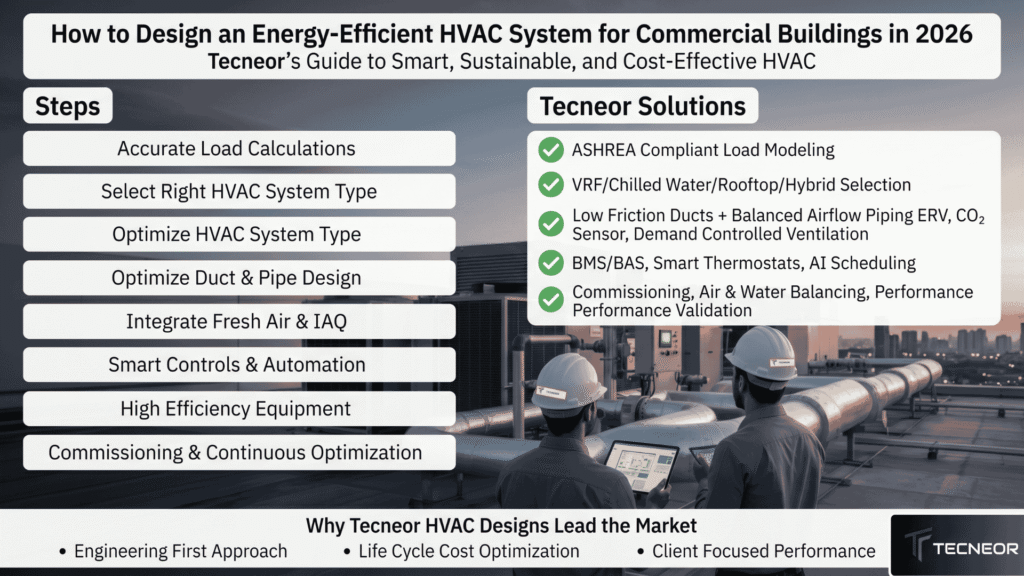
Introduction
Energy costs are rising, sustainability regulations are becoming stricter, and building owners now demand higher comfort with lower energy consumption. In 2026, HVAC design is no longer just about heating or cooling, it’s about creating intelligent, energy-efficient systems that provide long-term value.
At Tecneor, we design commercial HVAC systems that are not only compliant with today’s codes and standards but also future-ready, ensuring buildings operate efficiently for decades. This guide explains how to design an energy-efficient HVAC system that saves money, improves comfort, and increases asset value.
1. Start with Accurate Load Calculations
Why It Matters
Without precise load calculation, no HVAC system can operate efficiently. Oversized systems cycle frequently, wasting energy and increasing wear, while undersized systems fail to meet comfort requirements.
Tecneor’s Approach
Tecneor uses ASHRAE-based modeling tools to determine:
• Sensible and latent cooling/heating loads
• Heat gains from occupants, lighting, and equipment
• Envelope heat transfer, including walls, roofs, and glazing
• Solar radiation and shading impact
Accurate load calculations ensure proper equipment sizing, airflow, and system distribution, which are critical for energy efficiency and occupant comfort.
2. Choose the Right HVAC System Type
Why It Matters
Not every building benefits from the same system. Choosing the wrong system can result in high energy consumption, maintenance challenges, and poor comfort.
Options in 2026
• VRF / VRV systems – Ideal for flexible zoning and energy efficiency
• Chilled water plants – Suitable for large commercial or high-rise buildings
• Packaged rooftop units – Efficient for medium-sized buildings with roof space
• Hybrid systems – Combine air- and water-based solutions for optimal efficiency
Tecneor’s Selection Criteria
Tecneor evaluates:
• Building size, occupancy, and usage patterns
• Energy efficiency targets and sustainability goals
• Budget, life-cycle cost, and return on investment
• Maintenance strategy and ease of operations
Selecting the right system is the foundation for energy-efficient, long-lasting HVAC performance.
3. Optimize Duct & Pipe Design
Efficiency Starts with Distribution
Even high-efficiency equipment loses performance if airflow and water distribution are poorly designed. Bad ductwork increases static pressure, energy consumption, and noise, while poorly insulated pipes cause thermal losses.
Tecneor Designs
• Low-friction duct routes – Minimize bends, transitions, and constrictions
• Proper velocity control – Match airflow to space requirements without noise
• Balanced airflow networks – Ensure even cooling or heating across all zones
• Insulated chilled water and refrigerant piping – Minimize energy loss during distribution
Optimized duct and pipe design ensures energy savings of 10–20%, while also improving comfort and reducing equipment wear.
4. Integrate Fresh Air & Indoor Air Quality (IAQ) Systems
Why IAQ Matters
Occupants increasingly demand healthy, comfortable indoor environments. Energy-efficient design must not compromise air quality.
Tecneor Integrates
• Energy Recovery Ventilators (ERVs) – Recover energy from exhaust air to reduce heating/cooling loads
• Demand-Controlled Ventilation (DCV) – Adjust airflow based on occupancy using CO₂ sensors
• Advanced filtration – Remove particulates, pathogens, and allergens
• Humidity control – Maintain optimal relative humidity for comfort and energy efficiency
By integrating smart ventilation, Tecneor ensures energy savings while maintaining superior IAQ.
5. Use Smart Controls & Automation
The Role of Smart HVAC
Modern energy efficiency is data-driven. Intelligent control systems optimize HVAC operation in real time, reducing waste and maintaining comfort.
Tecneor Implements
• Building Management Systems (BMS / BAS) – Centralized control for all mechanical and electrical systems
• Smart thermostats – Room-level control and energy optimization
• Zoning controls – Tailor airflow and temperature per space usage
• AI-based scheduling – Adjust operation based on occupancy patterns, weather forecasts, and peak energy rates
Smart automation allows buildings to operate efficiently without compromising comfort, providing measurable energy savings.
6. Select High-Efficiency Equipment
Look Beyond Purchase Price
The most expensive upfront equipment may not be the most cost-effective long-term. Tecneor evaluates efficiency, durability, and operating cost.
Tecneor Specifies
• High-COP chillers – Reduce energy use per unit of cooling
• Inverter-driven compressors – Match output to demand, reducing part-load energy consumption
• ECM (Electronically Commutated Motors) fans – Reduce electrical load in variable air volume systems
• Energy Star–rated HVAC equipment – Verified efficiency compliance
Equipment selection directly impacts operating cost, environmental footprint, and system longevity.
7. Commissioning & Continuous Optimization
Why Commissioning Matters
Design is only complete when verified in real-world conditions. Without commissioning, systems may operate inefficiently or fail to meet comfort expectations.
Tecneor Performs
• System commissioning – Verify all components operate per design intent
• Air and water balancing – Ensure correct airflow and hydronic flow rates
• Performance validation – Measure energy use, temperature, and humidity performance
• Post-handover energy tuning – Fine-tune setpoints and schedules for long-term efficiency
Continuous optimization ensures the system remains efficient, reliable, and comfortable throughout its lifecycle.
Why Tecneor’s HVAC Designs Lead the Market
- Engineering-first approach – Every system is designed and verified using robust calculations and modeling.
- Life-cycle cost optimization – Focus on long-term energy savings and maintenance reduction.
- Future-ready systems – Incorporate emerging technologies and sustainability practices.
- Sustainability compliance – Meets or exceeds ASHRAE, LEED, and local energy codes.
- Client-focused performance – Systems designed to meet occupant comfort, operational goals, and budget targets.
Conclusion
Designing an energy-efficient HVAC system in 2026 requires more than just high-efficiency equipment. It demands:
• Accurate load calculation
• Smart equipment selection
• Optimized duct and pipe distribution
• Indoor air quality integration
• Intelligent controls and automation
• Rigorous commissioning and ongoing optimization
Tecneor delivers HVAC systems that are:
✔ Efficient today and tomorrow
✔ Comfortable for occupants
✔ Sustainable and compliant
✔ Optimized for long-term operational savings
With Tecneor, building owners achieve maximum comfort, minimal energy consumption, and enhanced asset value, ensuring their investment in HVAC systems pays dividends for years to come.