Introduction
When people admire a modern building, they usually notice the façade, the interiors, and the smart finishes. What they rarely see is what truly makes the building work: the Mechanical, Electrical, and Plumbing (MEP) systems hidden behind walls, ceilings, and floors. These systems control air, power, water, safety, and comfort, every essential function of the space.
At Tecneor, we believe that successful MEP field work is the backbone of every project. No matter how advanced the design is, a building can only perform as well as its on-site execution. Proper MEP field work ensures that systems are installed correctly, coordinated properly, tested thoroughly, and delivered ready for long-term operation. When done right, it saves time, controls costs, and prevents years of maintenance and performance problems.
What Is MEP Field Work?
MEP field work is the practical execution of MEP design on the construction site. It is where drawings, calculations, and specifications are transformed into real, working systems. Field engineers, supervisors, and technicians ensure that every component is installed in the correct location, at the right level, with the proper size, and according to approved standards.
MEP field work typically includes:
HVAC Installation
This involves placing and connecting:
- Ductwork, dampers, and diffusers
- Air handling units (AHUs), fan coil units (FCUs), and chillers
- Exhaust fans and fresh air systems
- Insulation and vibration control
The goal is to achieve correct airflow, thermal comfort, energy efficiency, and indoor air quality.
Electrical Systems
Electrical field work includes:
- Power and lighting cabling
- Cable trays and conduits
- Switchboards, panels, and transformers
- Earthing and bonding systems
- Emergency power and backup systems
Installations must strictly follow load calculations, safety rules, and local codes.
Plumbing and Firefighting Systems
This includes:
- Cold and hot water piping
- Drainage and vent systems
- Pumps, tanks, and valves
- Sprinklers, hose reels, and fire pumps
- Sanitary fixtures and accessories
Every slope, pressure rating, and connection point must be accurate to avoid leaks, blockages, and performance issues.
Why Field Supervision Matters
Even the best MEP design can fail if it is not executed properly on site. Field supervision is what turns intent into reality. Here’s why it is so critical:
1. Accuracy in Installation
Field engineers ensure that:
- Ducts are installed at the correct elevation and size
- Pipes follow the correct slope and routing
- Electrical conduits and trays are aligned and accessible
A small deviation can affect airflow, water flow, voltage drop, and system safety.
2. Clash Detection and Resolution
On site, different systems often compete for the same space. Without strong supervision:
- Ducts may block cable trays
- Pipes may interfere with structural beams
- Access to valves or panels may be compromised
Field engineers identify and resolve these conflicts early, preventing expensive rework later.
3. Code and Standard Compliance
MEP systems must comply with standards such as:
- ASHRAE for HVAC performance
- SMACNA for duct construction
- NFPA for fire protection
- Local electrical and plumbing codes
Field supervision ensures these rules are followed during installation—not just on paper.
4. Testing and Commissioning Readiness
Good installation prepares systems for smooth testing and commissioning:
- Ducts are sealed properly
- Pipes are pressure-tested
- Cables are correctly labeled
This reduces delays at handover and ensures the building performs as designed.
Tecneor’s MEP Field Work Strategy
At Tecneor, MEP field work is not reactive, it is structured, proactive, and quality-driven. Our approach is built around five key pillars:
1. Verification Before Installation
We cross-check:
- Approved drawings vs site conditions
- Ceiling heights vs routing space
- Structural elements vs MEP paths
This ensures the design is buildable in the real environment.
2. Continuous Inspection
Every duct, pipe, and cable run is inspected for:
- Alignment and support
- Proper clearances
- Correct materials and fittings
Issues are corrected immediately, not after completion.
3. Multidisciplinary Coordination
Our HVAC, electrical, plumbing, and fire teams work together, not in isolation. Regular coordination meetings ensure:
- No system blocks another
- Maintenance access is preserved
- Ceiling and shaft spaces are optimized
4. Real-Time Reporting
We maintain:
- Daily progress logs
- Inspection reports
- Site photos and updates
Clients always know what is happening, where progress stands, and what issues are being resolved.
5. Strong QA/QC Culture
Quality is not inspected at the end; it is built into every step. Our QA/QC process includes:
- Material verification
- Installation checklists
- Pre-commissioning inspections
This ensures long-term performance and reliability.
Common Challenges in MEP Field Work and How Tecneor Solves Them
Space Constraints
Modern buildings often have tight ceiling voids and crowded service zones. Tecneor uses:
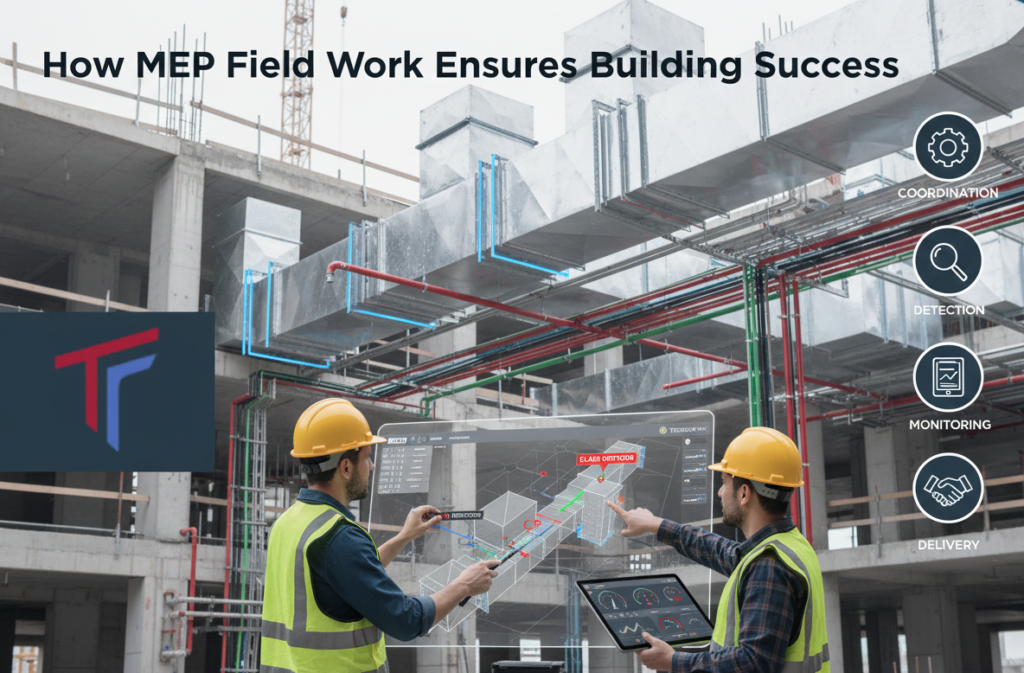
- 3D coordination models
- Early clash detection
- Optimized routing strategies
This ensures all systems fit without compromise.
Material Availability
Sometimes specified materials are not available on time. Our field engineers:
- Propose technically equivalent alternatives
- Get consultant/client approval
- Ensure compliance with performance and code requirements
Site Conditions
Dust, humidity, heat, and limited access can affect installation quality. Tecneor plans:
- Proper sequencing
- Temporary protection for equipment
- Controlled storage and handling
This keeps quality intact despite harsh conditions.
Design Changes
Projects evolve. Tecneor manages changes through:
- Clear documentation
- Revised drawings
- Controlled site instructions
So, changes don’t become chaos.
How MEP Field Work Adds Business Value
Strong MEP field execution is not just technical, it’s strategic. It delivers:
- Reduced rework and waste
- Fewer change orders
- Faster project delivery
- Lower operational and maintenance costs
- Higher client satisfaction
For owners, it means a building that performs as promised.
But for contractors, it means fewer disputes and smoother handover.
Whereas for operators, it means systems that last and work reliably.
Conclusion
MEP field work is where design becomes reality. It is not just about following drawings, it’s about precision, coordination, and problem-solving under real-world conditions.
At Tecneor, our field teams ensure that every duct, pipe, and cable is installed with purpose and care. We deliver MEP systems that are efficient, safe, compliant, and ready for long-term performance. When MEP field work is done right, buildings don’t just look good, they work flawlessly.