Introduction
A fire can destroy an entire commercial building in minutes not because the structure was weak, but because the fire protection system was poorly designed, installed, or maintained. In modern cities, fire safety is not optional. It is a legal requirement, a moral responsibility, and a critical part of sustainable building design.
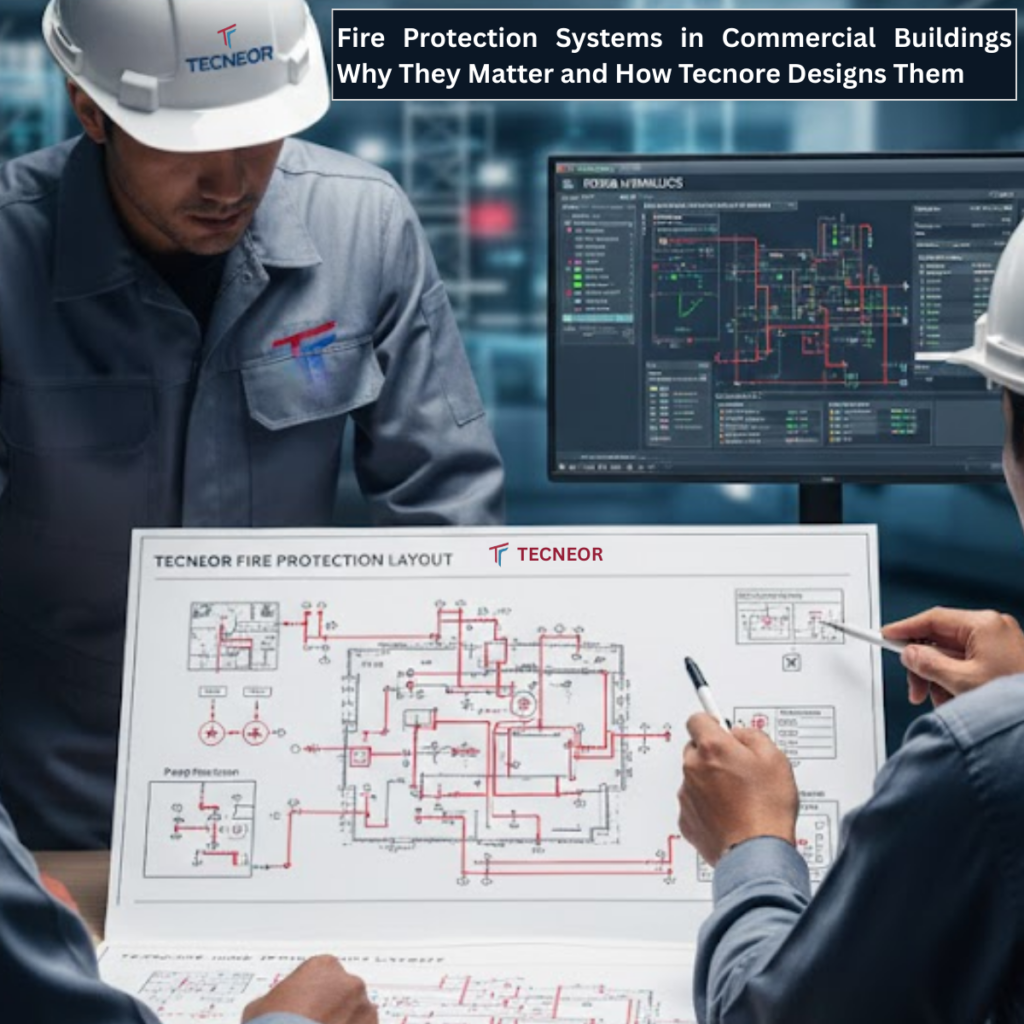
At Tecneor, we provide end-to-end fire protection engineering that ensures your building remains compliant, protected, and ready for emergency conditions. From early detection to active suppression and safe evacuation, Tecneor designs systems that save lives and protect assets.
Why Fire Protection Systems Matter
Commercial buildings contain people, equipment, data, and valuable assets. Without proper fire protection:
• Fire spreads rapidly through ceilings and ducts
• Smoke reduces visibility and causes suffocation
• Escape routes become blocked
• Property damage escalates dramatically
• Business operations stop
• Insurance claims become complicated or rejected
Fire protection systems are designed to achieve three main goals:
- Detect fire early
- Control or suppress fire quickly
- Allow safe evacuation
At Tecneor, every fire protection design is based on these life-safety principles.
The Three Pillars of Fire Protection
A complete fire protection strategy includes:
• Detection & Alarm – To alert occupants
• Suppression – To control or extinguish fire
• Evacuation & Smoke Control – To protect escape routes
Tecneor integrates all three into one coordinated system.
Types of Fire Protection Systems in Commercial Buildings
1. Fire Alarm Systems (Detection & Warning)
Fire alarm systems detect smoke, heat, or flame and notify occupants immediately.
Key Components Include:
• Smoke detectors
• Heat detectors
• Flame detectors
• Manual call points (break-glass units)
• Fire alarm control panels
• Audible alarms and visual strobes
Tecneor’s Design Focus:
• Zoning and addressability
• Interface with elevators, HVAC, and access control
• Battery backup and redundancy
• Compliance with NFPA 72 and local civil defense codes
Tecneor ensures alarm logic and cause-and-effect matrices are fully compliant and tested.
2. Fire Suppression Systems
Suppression systems control or extinguish fire before it spreads.
Common Types:
• Sprinkler Systems – Wet, dry, pre-action, deluge
• Clean Agent Systems – FM-200, Novec 1230 for data centers
• CO₂ Systems – For electrical and generator rooms
• Wet Chemical Systems – For kitchen hoods
Tecneor’s Engineering Includes:
• Hydraulic calculations
• Hazard classification
• Nozzle and head spacing
• Water tank and pump sizing
Every Tecneor design ensures sufficient flow, pressure, and coverage.
3. Firefighting Systems (Hydrants, Hose Reels, Pumps)
These allow trained staff and firefighters to fight fires directly.
Components Include:
• Fire hydrants
• Landing valves
• Hose reels
• Fire water storage tanks
• Fire pumps (main, standby, jockey)
Tecneor designs pump rooms with:
• Redundant pumps
• Emergency power supply
• Pressure maintenance (jockey pump)
• Compliance with NFPA 20
4. Smoke Management & Evacuation Systems
Smoke kills more people than flames. Tecneor integrates:
• Smoke exhaust systems
• Staircase pressurization
• Lobby pressurization
• Fire-rated dampers and doors
These keep escape routes clear during emergencies.
Tecneor’s Fire Protection Design Approach
Tecneor follows a structured, engineering-driven process:
1. Risk Assessment
We analyze:
• Occupancy type
• Fire load
• Building height and area
• Special hazards (data centers, kitchens, labs)
This defines system type and performance level.
2. Code & Standard Compliance
We design to:
• NFPA standards (13, 14, 20, 72, 92)
• Local civil defense regulations
• Insurance and authority requirements
Compliance is verified at every stage.
3. Hydraulic Calculations
Tecneor performs:
• Sprinkler flow calculations
• Hydrant system demand analysis
• Pump curve matching
• Water supply verification
This ensures correct pressure at the most remote point.
4. Equipment Selection
We select:
• Approved pumps
• UL/FM-listed detectors and panels
• Certified suppression agents
• Reliable valves and accessories
Only tested, compliant equipment is used.
5. System Integration
All fire systems communicate through a central fire alarm panel:
• Sprinklers → Alarm
• Smoke exhaust → Alarm
• Elevators → Alarm
• Access control → Alarm
Tecneor designs full cause-and-effect matrices.
6. Testing & Commissioning
Before handover, Tecneor performs:
• Flow and pressure tests
• Pump performance tests
• Alarm simulations
• Interlock verification
Nothing is accepted without proof of performance.
Why Clients Trust Tecneor
Clients choose Tecneor because we deliver:
• Code-compliant designs
• Clear documentation
• Reliable system performance
• Smooth authority approvals
• Life-safety-focused engineering
Fire protection is not about drawings—it’s about responsibility.
Benefits of a Properly Designed Fire Protection System
• Saves lives
• Reduces property damage
• Protects business continuity
• Improves insurance terms
• Enhances building value
Tecneor ensures every building is ready for the unexpected.
Conclusion
Fire protection is not just about meeting code—it is about protecting lives, property, and the future of your business.
At Tecneor, we design fire protection systems with unmatched precision, compliance, and accountability. From detectors to pumps, alarms to suppression, every component is engineered for reliability under real emergency conditions.
Your building’s safety is our priority.
Tecneor — Engineering Protection. Saving Lives.