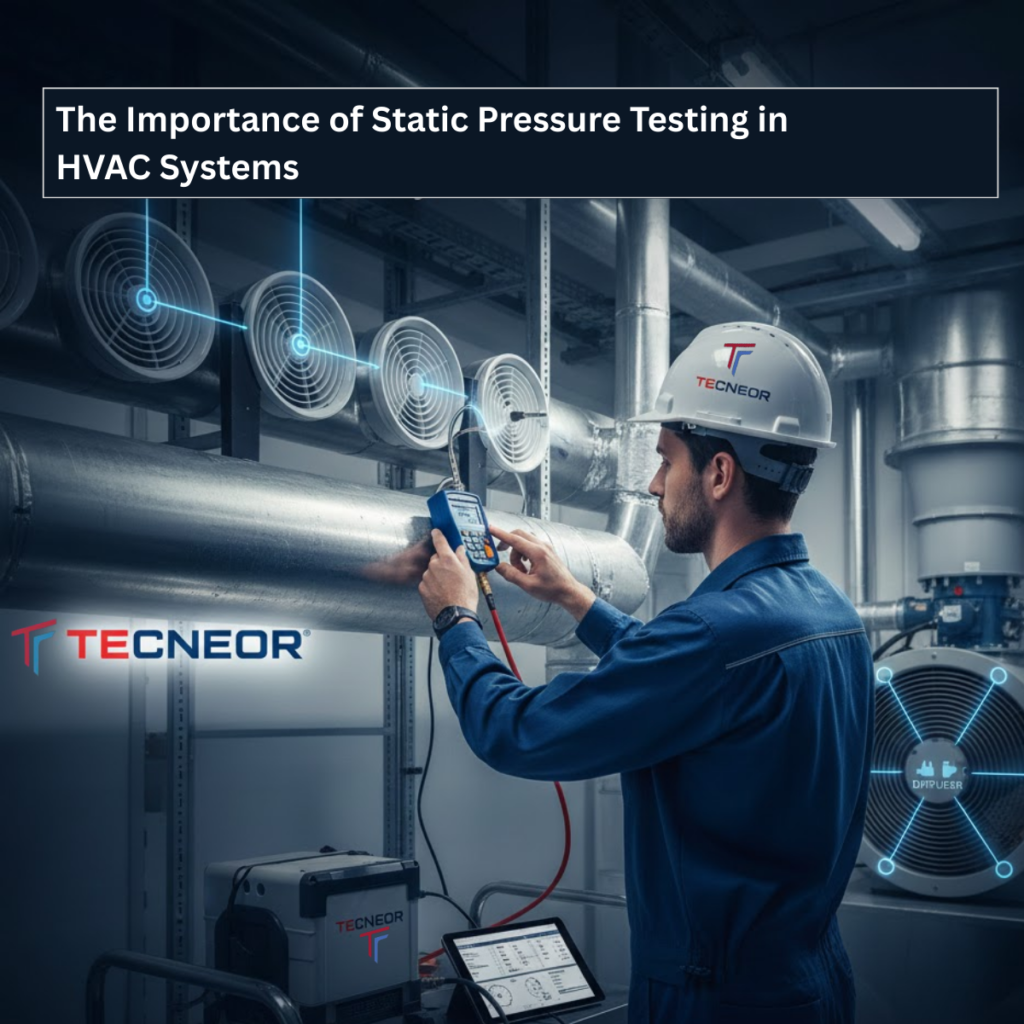
Introduction
Airflow is the heart of every HVAC system. No matter how advanced the equipment or how efficient the design, a system cannot perform properly if air does not move through it as intended. This is where static pressure testing becomes critical. It is the key diagnostic tool that verifies whether your ductwork, fans, and air distribution system are working in harmony.
Poorly tested HVAC ducts lead to energy waste, uneven temperatures, noise complaints, and shortened equipment life. At Tecneor, we prioritize precise static pressure testing as a core part of commissioning and quality control. Our goal is to ensure every HVAC system delivers the comfort, efficiency, and reliability it was designed for.
What Is Static Pressure in HVAC?
In simple terms, static pressure is the resistance that airflow encounters as it moves through a duct system. It is created by:
• Duct length and size
• Bends and fittings
• Filters and coils
• Dampers and grilles
• Leakage and restrictions
Static pressure is usually measured in inches of water column (in. w.g.) or Pascals (Pa). Every HVAC fan is designed to operate within a specific static pressure range. When pressure is too high or too low, system performance suffers.
Incorrect static pressure can result in:
• Noise in ductwork
• Uneven cooling or heating
• Poor indoor air quality
• Excessive energy usage
• Premature fan and motor failure
At Tecneor, we don’t guess airflow—we measure and verify it.
Why Static Pressure Testing Matters
Static pressure testing is not just a checkbox item—it is a performance guarantee. Proper testing ensures that the system matches the engineer’s design intent.
1. Duct Sealing Verification
Leaks are one of the biggest causes of airflow loss. Even a small gap in duct joints can waste large volumes of conditioned air.
Testing helps to:
• Identify leakage locations
• Measure total air loss
• Verify duct tightness class
Tecneor uses pressure tests to ensure ducts meet SMACNA leakage class requirements.
2. Airflow Verification
Design drawings specify how much air (CFM or L/s) each space should receive. Static pressure testing helps confirm that:
• Air reaches all zones
• No area is starved or overfed
• The distribution system is balanced
This is essential for comfort, ventilation, and temperature control.
3. Fan Performance Check
Fans are selected based on required airflow and total system pressure. If actual pressure is higher than expected, the fan may:
• Deliver less air than designed
• Consume more power
• Overheat or fail early
Testing ensures fans operate within their design operating point.
4. System Balancing
Static pressure testing is a foundation for air balancing. Balanced systems mean:
• Uniform pressure across zones
• Even temperatures
• Quiet operation
• Reduced energy waste
At Tecneor, no HVAC system is handed over without full testing, adjusting, and balancing (TAB).
Common Causes of High Static Pressure
Understanding what increases pressure helps prevent problems:
• Undersized ducts
• Too many sharp bends
• Closed or improperly set dampers
• Dirty filters and coils
• Blocked diffusers
• Poor duct installation
Tecneor identifies and corrects these issues before handover.
Static Pressure Testing Methods
There are several professional methods used to test and verify static pressure in HVAC systems.
1. Fan Pressurization Test
A calibrated fan is used to pressurize the duct system to a specific pressure level. The pressure drop is measured to determine leakage and resistance.
Used to:
• Test duct tightness
• Verify installation quality
2. Duct Leakage Test
This measures how much air escapes from the ductwork at a given pressure.
Results are expressed as:
• CFM of leakage
• Percentage of total airflow
Tecneor ensures leakage is within SMACNA and project limits.
3. Flow Measurement at Diffusers
Using anemometers or flow hoods, airflow is measured at:
• Diffusers
• Grilles
• Registers
This confirms that actual airflow matches design values.
4. Total External Static Pressure (TESP) Test
TESP is measured across the fan to verify:
• Fan capability
• System resistance
• Operating efficiency
Tecneor records and analyzes TESP for every major air-handling unit.
Standards That Govern Static Pressure Testing
At Tecneor, we follow internationally recognized standards, including:
• SMACNA (Sheet Metal and Air Conditioning Contractors’ National Association)
• ASHRAE Guidelines
• CIBSE (where applicable)
• Local authority and code requirements
These standards define acceptable leakage classes, testing pressures, and performance benchmarks.
Tecneor’s Approach to Static Pressure Testing
Static pressure testing is built into Tecneor’s project workflow:
✔ Design Review
We analyze duct layouts for pressure efficiency before installation.
✔ Pre-Testing Inspections
All joints, seals, and fittings are checked before pressurization.
✔ On-Site Testing
Certified technicians perform fan pressurization and airflow measurements.
✔ Adjustment & Balancing
Dampers and diffusers are set to achieve design airflow.
✔ Final Verification & Reporting
Clients receive detailed test reports and performance data.
Benefits of Proper Static Pressure Testing
When static pressure is tested and optimized, the benefits are immediate and long-term:
• Improved thermal comfort
• Lower energy bills
• Reduced noise
• Longer equipment life
• Fewer maintenance calls
• Higher indoor air quality
At Tecneor, we see testing as an investment—not a cost.
Why Clients Trust Tecneor
Clients choose Tecneor because we:
• Follow proven engineering methods
• Use calibrated testing equipment
• Provide transparent documentation
• Deliver systems that perform as designed
Static pressure testing is one of the ways Tecneor turns drawings into real-world performance.
Conclusion
Static pressure testing is more than a technical formality—it is the guarantee of HVAC system performance, comfort, and energy efficiency. Without it, even the best-designed system can fail to deliver results.
At Tecneor, our expertise ensures that every duct, fan, and diffuser works exactly as intended. Through precise testing, balancing, and verification, we deliver HVAC systems that are efficient, reliable, and built to last. If you want HVAC performance you can trust, Tecneor is your partner in quality.