Introduction
A common but often overlooked cause of HVAC underperformance is improper placement of indoor and outdoor units. Even perfectly sized, high-efficiency HVAC equipment will fail to deliver optimal comfort if the units are installed in the wrong location.
At Tecneor, we frequently inspect systems where poor placement causes:
• Inefficient cooling or heating
• Higher energy bills
• Noise and vibration issues
• Frequent maintenance calls
• Premature wear of fans and compressors
This article explores why correct placement matters, identifies common mistakes, and explains how Tecneor ensures HVAC systems deliver maximum performance for every building.
Why Correct Placement Matters
The location of indoor and outdoor HVAC units affects nearly every aspect of system performance:
1. Airflow Efficiency
Proper airflow is critical for delivering conditioned air to every corner of a space. Improper placement can:
• Restrict airflow around indoor units
• Reduce cooling/heating output
• Create uneven temperatures and hot/cold spots
• Cause coil icing and inefficient operation
Tecneor designs unit locations to maximize airflow and throw, ensuring rooms reach their intended comfort levels.
2. Energy Consumption
When HVAC units operate under high ambient temperatures, blocked airflow, or reflective surfaces:
• Fans and compressors work harder
• Energy consumption increases
• Cooling and heating efficiency drops
Correct placement ensures units run at design load, minimizing unnecessary energy usage and operational costs.
3. Noise Levels
Indoor units near bedrooms, offices, conference rooms, or quiet areas can transmit sound, vibration, and duct-borne noise. Outdoor units placed near windows or occupied spaces create disturbance. Proper placement reduces complaints and improves occupant comfort.
4. Equipment Longevity
Poor placement forces equipment to compensate for heat gain, airflow restriction, or environmental exposure:
• Compressors and fans experience higher stress
• Condenser and evaporator coils age faster
• Refrigerant lines overwork, leading to leaks
• Overall equipment lifespan decreases
Tecneor ensures all units are sited for optimal thermal and operational conditions.
5. Maintenance Accessibility
HVAC units require regular service: cleaning filters, inspecting coils, topping up refrigerant, and checking controls. Units placed in tight corners, high ceilings, or behind obstacles complicate maintenance, increasing downtime and service costs. Tecneor prioritizes accessibility in every placement plan.
Common Placement Mistakes
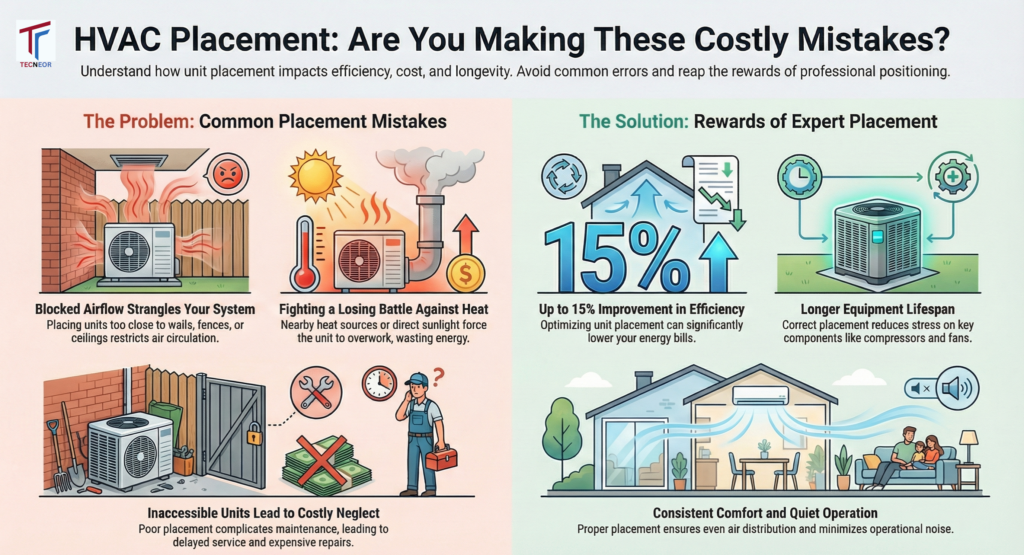
Understanding common mistakes helps prevent recurring issues. Tecneor encounters the following frequently:
1. Indoor Units Too Close to Walls or Ceilings
• Restricts airflow and reduces throw distance
• Creates uneven room temperatures
• Causes coil icing and reduced efficiency
Tecneor Solution: We maintain adequate clearance above, below, and around units for maximum airflow.
2. Placing Units Near Heat Sources
• Ovens, kitchen equipment, or electronics increase ambient temperature
• AC units work harder to compensate, increasing energy consumption
Tecneor Solution: Indoor units are positioned away from heat sources and sunlight to reduce load on equipment.
3. Outdoor Units in Direct Sunlight
• Exposed to high ambient temperatures, which increases suction and discharge pressures
• Reduces compressor efficiency
• Accelerates coil degradation
Tecneor Solution: Units are installed in shaded areas whenever possible, with proper orientation to avoid direct sun exposure during peak hours.
4. Restricted Outdoor Unit Clearance
• Walls, fences, shrubs, or other obstacles block airflow
• Fans must work harder, consuming more energy
• Overheating and compressor stress increase
Tecneor Solution: Tecneor ensures manufacturer-recommended clearances on all sides, top, and back of outdoor units. Proper ventilation is verified on-site.
5. Poor Accessibility for Maintenance
• Units in hard-to-reach areas complicate service, filter changes, and refrigerant charging
• Maintenance is delayed, leading to efficiency loss and equipment deterioration
Tecneor Solution: Tecneor prioritizes service access during design, placing units for safe and easy maintenance without compromising aesthetics.
Tecneor’s Placement Strategy
At Tecneor, we combine engineering analysis with practical site considerations to determine the perfect indoor and outdoor unit location.
1. Indoor Unit Placement
• Ensure adequate clearance from walls and ceilings
• Avoid locations near heat sources or high sunlight exposure
• Use airflow modeling for large or irregular spaces
• Ensure convenient access for maintenance, filter cleaning, and inspection
• Coordinate with architectural and interior design constraints
This approach optimizes cooling/heating distribution while maintaining aesthetics.
2. Outdoor Unit Placement
• Install units in shaded, ventilated areas wherever possible
• Provide minimum clearance around units per manufacturer guidelines
• Avoid blocking airflow with walls, shrubs, or fences
• Consider vibration isolation to reduce transmitted noise
• Protect units from rain, dust, and debris
Tecneor ensures outdoor units operate efficiently and quietly while being durable and serviceable.
3. Site-Specific Optimization
Every building is unique. Tecneor performs on-site analysis to consider:
• Sun orientation and shading
• Prevailing wind patterns
• Space constraints and building layout
• Architectural aesthetics
Placement is not one-size-fits-all. Tecneor customizes each system for maximum performance.
4. Performance Verification
After installation, Tecneor engineers:
• Measure airflow from indoor units
• Check suction and discharge pressures
• Verify energy consumption
• Ensure the system delivers the design cooling or heating capacity
This step guarantees that the placement achieves the intended efficiency and comfort levels.
Benefits of Correct Placement
Proper placement offers measurable benefits:
• Efficient Cooling & Heating — Uniform temperature across all spaces
• Lower Energy Bills — Units run at design efficiency
• Longer Equipment Life — Reduced stress on compressors and fans
• Reduced Noise & Vibrations — Quieter operation
• Ease of Maintenance — Lower downtime and service costs
Clients often notice 10–15% improvement in energy efficiency and comfort simply by optimizing indoor and outdoor unit placement.
Tecneor’s Engineering Advantage
Clients trust Tecneor because our placement strategy is:
• Data-Driven — Based on airflow modeling, pressure calculations, and environmental analysis
• Standards-Compliant — Meets ASHRAE, SMACNA, and manufacturer guidelines
• Practical — Considers real-world accessibility, aesthetics, and safety
• Verified — Performance tested post-installation to ensure results
Placement is not guesswork at Tecneor—it is a carefully engineered step toward efficient, long-lasting HVAC performance.
Conclusion
Incorrect placement of indoor or outdoor units is a silent energy killer and comfort destroyer. Even high-end, perfectly sized HVAC systems will underperform if installed in unsuitable locations.
Tecneor’s placement strategy ensures that every unit is installed with maximum airflow efficiency, energy performance, accessibility, and long-term reliability. Proper placement not only enhances comfort but also protects your investment, reduces energy bills, and extends equipment life.
With Tecneor, HVAC systems perform as designed—efficiently, quietly, and reliably—because placement matters as much as equipment quality.