Introduction
When HVAC systems underperform, many people blame the equipment: the chiller, the air-handling unit, or the compressor. In reality, one of the most overlooked and damaging culprits is poor insulation of ducts and copper refrigerant lines. Heat gain or heat loss through uninsulated or poorly insulated surfaces can drastically reduce efficiency, increase energy bills, and compromise occupant comfort.
At Tecneor, we frequently encounter insulation errors in both residential and commercial projects. From sweating copper lines in plant rooms to hot supply ducts above false ceilings, poor insulation silently sabotages HVAC performance. It increases running costs, shortens equipment life, and creates moisture-related problems that damage buildings.
This article explains why insulation is critical in HVAC systems and how Tecneor ensures your ducts and pipes are insulated correctly for maximum efficiency and long-term reliability.
Why Insulation Is Critical in HVAC Systems
Insulation is not just about comfort—it is about energy conservation, system protection, and building health. Ducts and copper pipes carry either cooled air, heated air, chilled water, or refrigerant. Any uncontrolled heat exchange between these systems and the surrounding environment reduces performance.
1. Minimizes Thermal Loss and Heat Gain
Ducts and copper pipes are the “highways” of your HVAC system. Without proper insulation:
• Supply air gains heat in cooling mode
• Return air loses heat before reaching the unit
• Chillers and air conditioners must work harder
• Boilers and heaters lose valuable energy
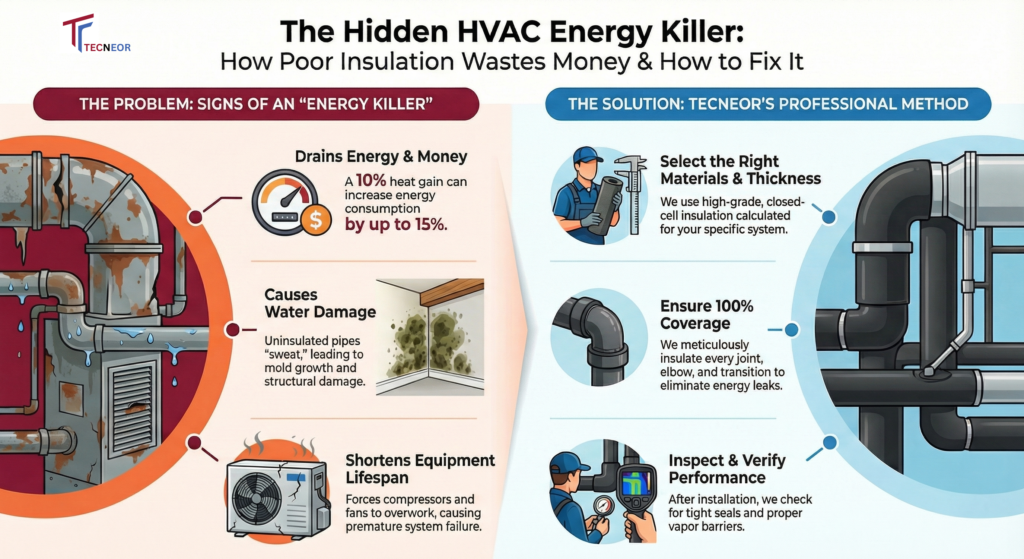
Even a 10% heat gain in a supply duct can increase total energy consumption by up to 15% over time. At Tecneor, we design insulation systems to protect every bit of conditioned energy you pay for.
2. Prevents Condensation and Water Damage
When cold surfaces are exposed to warm, humid air, condensation forms. This is commonly seen as “sweating” on copper refrigerant lines and chilled ducts.
Condensation causes:
• Ceiling stains and paint damage
• Mold and mildew growth
• Structural deterioration
• Corrosion of metal supports
Tecneor ensures proper insulation thickness and vapor barriers so surface temperatures always remain above the dew point.
3. Enhances Indoor Comfort
Poor insulation leads to inconsistent temperatures:
• Hot spots in air-conditioned rooms
• Cold drafts near uninsulated ducts
• Temperature fluctuations between zones
Good insulation maintains consistent air temperature all the way from the unit to the diffuser. Tecneor designs for uniform comfort, not just cold air at the source.
4. Extends HVAC Equipment Life
When insulation fails, HVAC equipment must compensate for energy losses. This leads to:
• Compressor overwork
• Fan and motor overload
• Coil icing or overheating
• Short cycling and early failure
Tecneor protects your investment by ensuring your equipment operates at its design load, not under constant stress.
Common Insulation Mistakes in HVAC Installation
Despite its importance, insulation is often rushed, ignored, or installed incorrectly. Here are the most common mistakes Tecneor encounters in the field:
1. Using the Wrong Insulation Material
Some contractors use cheap foam or thin sheets instead of proper closed-cell elastomeric insulation.
This leads to:
• Poor thermal resistance
• Early deterioration
• Moisture absorption
• Mold formation
Tecneor only uses high-quality, tested insulation materials with low thermal conductivity (k-value).
2. Incorrect Insulation Thickness
Insulation thickness must be calculated based on:
• Pipe or duct diameter
• Refrigerant or chilled water temperature
• Ambient temperature and humidity
Thin insulation is almost useless for chilled water or low-temperature refrigerant lines. Tecneor performs thickness calculations to prevent both heat gain and condensation.
3. Incomplete Coverage
Many installers insulate only straight duct sections and forget:
• Elbows
• Transitions
• Valves
• Flexible connections
• Branch take-offs
Every uninsulated section becomes an energy leak. Tecneor ensures 100% coverage, including fittings and accessories.
4. Poor Vapor Barrier Installation
Without a proper vapor barrier:
• Moisture penetrates insulation
• Sweating occurs
• Insulation becomes saturated and ineffective
Tecneor applies sealed vapor barriers with proper overlaps and approved tapes.
5. No Quality Verification
Most insulation work is hidden behind ceilings and walls, and many projects skip final inspections.
Small gaps, cuts, or missing pieces can compromise the entire system. Tecneor performs full visual and thermal inspections before approval.
Tecneor’s Approach to Proper HVAC Insulation
At Tecneor, insulation is treated as a critical engineering system, not a finishing item.
1. Smart Material Selection
Tecneor selects insulation based on:
• Thermal conductivity (k-value)
• Moisture resistance
• Fire performance
• Durability
• Compliance with ASHRAE and SMACNA
We match materials to application: ducts, refrigerant lines, chilled water pipes, and hot water lines.
2. Engineering the Correct Thickness
Tecneor calculates insulation thickness using:
• Operating temperature of the system
• Ambient conditions
• Pipe/duct size
• Dew point analysis
This ensures minimal heat gain/loss and zero condensation.
3. Complete and Continuous Coverage
Tecneor insulates:
• Straight ducts and pipes
• Elbows, joints, and flanges
• Valves and fittings
• Flexible connectors
No thermal bridge is left exposed.
4. High-Quality Vapor Barriers
For chilled systems, Tecneor uses high-grade vapor barrier tapes and coatings to prevent moisture ingress.
All joints are sealed tightly to stop humid air from reaching cold surfaces.
5. Inspection & Verification
After installation, Tecneor engineers inspect insulation for:
• Uniform coverage
• Correct thickness
• Tight seals at joints
• Proper vapor barrier application
We also perform surface temperature checks to verify that energy loss is within acceptable limits.
Benefits of Proper HVAC Insulation
When insulation is done right, the results are immediate and long-term:
• Lower energy bills
• Improved thermal comfort
• No sweating or moisture damage
• Reduced noise from ducts
• Longer equipment life
• Fewer maintenance issues
At Tecneor, insulation is one of the highest ROI upgrades in any HVAC project.
Why Clients Trust Tecneor
Clients rely on Tecneor because we:
• Engineer insulation systems—not just install them
• Follow international standards
• Use proven materials
• Inspect and verify performance
• Deliver long-term efficiency
Tecneor ensures your HVAC system performs as designed, not as guessed.
Conclusion
Poor insulation may be invisible, but it silently kills HVAC efficiency, increases energy bills, and reduces occupant comfort. It also damages buildings through condensation and shortens equipment life.
By ensuring correct insulation material, thickness, vapor barrier, and complete coverage, Tecneor transforms underperforming systems into high-efficiency, long-lasting HVAC installations.
Proper insulation isn’t optional—it’s an energy-saving necessity.
With Tecneor, efficiency starts where you can’t see it—but where it matters most.