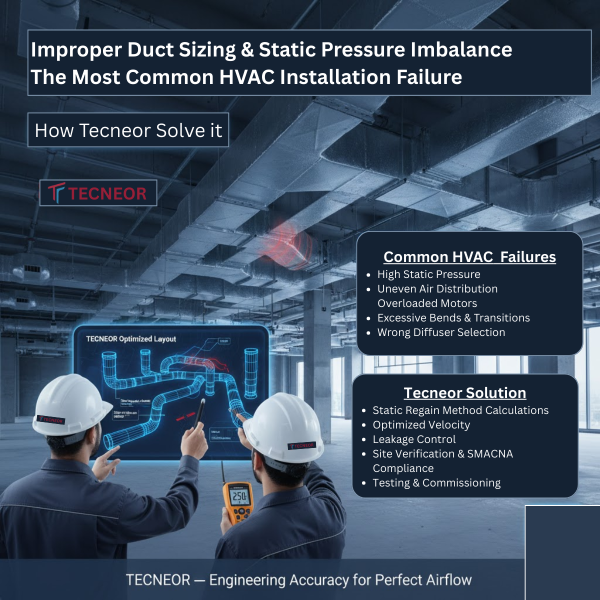
Introduction
In every HVAC project—whether it’s a commercial tower, a villa, a restaurant, or an industrial facility—the success of the entire cooling or heating system depends heavily on proper duct sizing and static pressure balance. Yet, duct design and installation remain one of the most frequently overlooked and poorly executed aspects of HVAC engineering.
The consequences of improper duct sizing are significant:
• High static pressure
• Noisy airflow
• Unbalanced supply
• Hot and cold spots
• Increased energy consumption
• Premature equipment wear
At Tecneor, we often inspect systems where poor duct sizing and static pressure imbalance compromise the entire HVAC performance. Many installers rely on guesswork rather than precise calculations, which creates long-term inefficiencies and higher operational costs.
This article explores why duct sizing is critical, the common mistakes in projects, and how Tecneor designs, verifies, and rectifies duct systems to deliver perfect airflow, energy efficiency, and occupant comfort.
Why Duct Sizing Matters More Than Most People Realize
Most clients assume that the HVAC unit itself is the key to comfort. While the unit is important, the ducting system is what actually delivers conditioned air efficiently to every space.
Incorrect duct sizing can make even the best AC units underperform. The impacts include:
1. High Static Pressure — A Noisy System
Undersized ducts increase air resistance. This forces fans to work harder, leading to:
• Excessive vibration
• Noise in supply and return air
• Increased energy consumption
• Accelerated wear on fans and motors
Tecneor ensures static pressure remains within design limits, delivering quiet and efficient operation.
2. Uneven Air Distribution
Some rooms may become overcooled, while others remain warm. Poor duct sizing prevents uniform air delivery, creating hot and cold spots that frustrate occupants. Tecneor designs duct systems to balance airflow across all zones, ensuring consistent comfort.
3. Overloaded Motors & High Energy Bills
When airflow is restricted:
• Fans must operate at higher RPMs
• Motors run hotter, increasing maintenance requirements
• Energy consumption rises significantly
Proper sizing ensures fans operate at optimal speed, reducing energy costs and maintenance frequency.
4. Weak Return Air — Choked Cooling
Return air pathways are often neglected. Restricted return air causes:
• Collapsed airflow in conditioned spaces
• Reduced cooling efficiency
• Excessive static pressure in air handling units (AHUs)
Tecneor designs both supply and return duct networks for maximum airflow balance.
5. Premature Failure of AHUs and FCUs
Air handling units (AHUs) and fan coil units (FCUs) are designed for specific static pressure limits. Improperly sized ducts force units to exceed these limits, causing:
• Fan motor stress
• Coil damage
• Frequent breakdowns
Tecneor ensures that unit design parameters and duct layout are perfectly matched.
Common Causes of Duct Sizing Failures in Projects
Understanding typical errors helps prevent recurring issues. The most common causes include:
1. Rule-of-Thumb Duct Sizing
Some installers rely on rough estimates instead of engineering calculations:
“Sir, this size duct usually works.”
Such shortcuts may appear faster initially but lead to serious airflow and static pressure problems. Tecneor always applies SMACNA, ASHRAE, and Static Regain Method (SRM) principles.
2. Incorrect Velocity Selection
Air velocity in ducts must match:
• Noise requirements
• Room type and function
• Duct material
• Fan capacity
For instance, using 600 FPM where 900 FPM is required, or vice versa, results in excessive noise, turbulence, or insufficient airflow.
3. No Static Pressure Calculations
Failing to calculate friction loss and losses at fittings, elbows, and transitions makes systems unpredictable. Tecneor calculates total static pressure drop, ensuring the fan selection matches real-world conditions.
4. Excessive Bends, Reducers, and Transitions
Improper duct routing adds unnecessary resistance, increases turbulence, and elevates noise levels. Tecneor engineers duct paths with minimal pressure loss.
5. Duct Leakage at Joints
Even small leaks reduce airflow and cooling efficiency. Tecneor uses SMACNA-class sealing to ensure negligible energy loss.
6. Wrong Diffuser or Grille Selection
If diffusers are mismatched with duct velocity or airflow, air throw and spread suffer, creating discomfort. Tecneor carefully selects diffusers, grilles, and registers for optimal performance.
How Tecneor Ensures Perfect Duct Sizing & Static Balance
At Tecneor, we eliminate ducting and static pressure issues using engineering precision, advanced calculation methods, and internationally accepted standards.
1. Static Regain Method (SRM)
SRM converts velocity pressure into static pressure along ducts. Tecneor applies SRM to:
• Ensure balanced static pressure across all branches
• Minimize fan energy consumption
• Reduce duct noise
• Achieve even airflow distribution
SRM is particularly effective in large commercial or industrial HVAC systems.
2. Full Friction Loss Calculations
Tecneor calculates friction loss per 100 ft of duct, considering:
• Bends, elbows, and transitions
• Dampers and diffusers
• Fan selection
• Material roughness
This ensures real-world performance matches design expectations.
3. Duct Velocity Optimization
Tecneor follows ASHRAE velocity standards based on space function:
• Bedrooms: 600–800 FPM
• Offices: 800–900 FPM
• Corridors: 1000–1100 FPM
• Main supply trunks: 1200–1500 FPM
This ensures quiet, comfortable, and efficient airflow.
4. Leakage Control
Tecneor enforces strict SMACNA sealing classes, minimizing leaks at joints, elbows, and connections. Reduced leakage translates to higher energy efficiency and uniform cooling.
5. Site Supervision & Verification
Tecneor engineers supervise installation, verifying:
• Duct dimensions
• SMACNA supports and spacing
• Sealing and insulation quality
• Proper alignment and leveling
• Airflow balancing
Hands-on supervision ensures no design detail is compromised.
6. Testing & Commissioning
Once installed, Tecneor performs:
• Pitot tube testing
• Static pressure measurements
• Airflow balancing
• Fan RPM verification
Only after these steps is the system considered fully operational and balanced.
Benefits of Proper Duct Sizing & Static Pressure Balance
Correct sizing and static pressure management result in:
• Efficient Cooling & Heating — Uniform temperature across rooms
• Lower Energy Bills — Fans operate at optimal speed
• Longer Equipment Life — Reduced fan and compressor stress
• Reduced Noise — Quiet and comfortable environments
• Simplified Maintenance — Easier troubleshooting and less wear
Clients often notice 10–20% improvement in energy efficiency and comfort just from properly sized ducts.
Pro-Installation Hack: Quick Verification
Before final installation, Tecneor recommends a simple site check:
- Measure duct cross-sections and compare with design drawings.
- Check airflow direction and fan RPM.
- Use a pitot tube or anemometer to verify air velocity.
This quick verification prevents costly rework after drywall or ceiling installation.
Conclusion
Incorrect duct sizing and static pressure imbalance are the silent killers of HVAC performance. They lead to noise, uneven cooling, energy waste, and premature equipment failure.
Tecneor’s engineering-first approach ensures every duct, diffuser, and fan operates in harmony, delivering maximum efficiency, comfort, and longevity. From initial design to installation, supervision, and commissioning, Tecneor guarantees HVAC systems that perform exactly as intended.
With Tecneor, proper duct sizing isn’t optional, it’s the foundation of HVAC success.