Introduction
Most HVAC failures don’t occur because of faulty equipment—they happen due to incorrect refrigerant charging. Refrigerant is the lifeblood of any cooling system. Too much or too little, and the system suffers silently. The consequences include:
• Higher energy consumption
• Poor cooling and heating performance
• Compressor strain or damage
• Shortened system lifespan
• Frequent maintenance calls
At Tecneor, we encounter refrigerant charging errors frequently on both commercial and residential projects. Many installers rely on guesswork or incomplete methods rather than precise calculation and measurement. The result is systems that appear to work but never reach their design efficiency.
This article explores why proper refrigerant charging is critical, common errors that compromise performance, and how Tecneor ensures HVAC systems run perfectly from day one.
Why Refrigerant Charging Matters
Refrigerant is responsible for transferring heat from the indoor space to the outdoor unit. Its quantity and pressure directly impact every aspect of HVAC system performance:
• Efficient cooling and heating — Proper refrigerant ensures the system reaches design capacity.
• Energy optimization — Correct levels reduce unnecessary energy consumption.
• Compressor longevity — Prevents overwork and overheating.
• Preventing coil icing — Proper evaporation and condensation avoid frost build-up.
• System reliability — Ensures consistent comfort and operational stability.
Incorrect refrigerant levels can have dramatic effects:
Undercharged systems:
• Reduced cooling capacity
• High superheat
• Increased compressor workload
• Frequent cycling and uneven cooling
Overcharged systems:
• Excess system pressure
• Reduced efficiency
• Oil dilution in compressors
• Risk of compressor burnout
Even minor deviations of 5–10% from the correct charge can reduce efficiency by 20% or more, demonstrating the critical importance of precision.
Common Causes of Incorrect Refrigerant Charging
Understanding the root causes of refrigerant errors helps prevent them. The most common mistakes include:
1. Lack of Proper Measurement Tools
Many technicians rely on “feel” or visual inspection instead of:
• Digital manifold gauges
• Refrigerant scales
• Temperature probes
• Pressure-temperature charts
Without precise instruments, the system cannot be charged accurately.
2. Skipping Superheat & Subcooling Checks
Superheat (for evaporators) and subcooling (for condensers) are essential for proper refrigerant performance. Ignoring these checks leads to:
• Overcharging or undercharging
• Coil icing
• Reduced system efficiency
Tecneor ensures both superheat and subcooling are verified for every system.
3. Incorrect Pipe Length Compensation
Longer or shorter refrigerant lines than the design require adjustment to the factory charge. Failure to account for line length:
• Alters refrigerant volume in the system
• Reduces cooling efficiency
• Strains the compressor
Tecneor calculates the exact additional or reduced charge required based on line length and diameter
4. Reuse of Refrigerant
Recycling refrigerant without proper testing can introduce:
• Moisture contamination
• Acid formation
• Reduced heat transfer efficiency
Tecneor strictly uses new, high-purity refrigerant unless reclaimed refrigerant is tested and certified.
5. Lack of Training and Awareness
Refrigerant handling is a precise process. Improper training leads to:
• Overcharging or undercharging
• Environmental hazards
• Equipment damage
Tecneor ensures all engineers and technicians are highly trained and certified in refrigerant management.
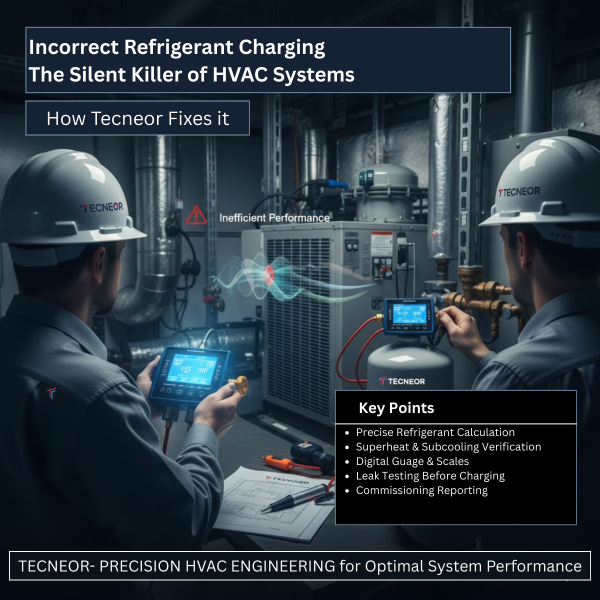
Tecneor’s Approach to Proper Refrigerant Charging
At Tecneor, refrigerant charging is treated as a high-precision engineering process, not just a routine installation step.
1. Precise Refrigerant Calculation
Tecneor calculates the exact charge based on:
• Piping length and diameter
• Evaporator and condenser coil sizes
• Factory charge vs. additional piping
• Superheat and subcooling targets
This ensures every system receives the exact amount required for optimal performance.
2. Digital Tools & High-Accuracy Gauges
We use:
• Digital manifold gauges
• Refrigerant scales
• Temperature probes and pressure transducers
This equipment ensures the system is charged to design specifications, eliminating guesswork.
3. Superheat & Subcooling Verification
After charging, Tecneor engineers verify:
• Superheat at the indoor coil to ensure proper evaporation
• Subcooling at the condenser to ensure proper condensation
This prevents underperformance, compressor strain, and energy inefficiency.
4. Leak Testing Before Charging
A precise refrigerant charge is useless if the system leaks. Tecneor ensures:
• All joints, brazes, and connections are leak-free
• Nitrogen or inert gas testing confirms integrity
• Environmental protection compliance is maintained
5. Commissioning & Documentation
Tecneor provides complete commissioning and reporting:
• Refrigerant charge recorded
• Operating pressures and temperatures measured
• Performance verified against design specifications
Clients receive full traceability and peace of mind.
The Risks of Ignoring Proper Refrigerant Charging
Systems with incorrect refrigerant charging can lead to:
• High energy bills — Fans and compressors work harder
• Poor comfort — Uneven cooling, humidity issues, hot/cold spots
• Premature compressor failure — Increased maintenance and downtime
• Refrigerant leaks — Environmental hazards and regulatory fines
• High maintenance costs — Frequent system interventions
In large commercial installations, even small charging errors can cost tens of thousands of dollars annually in energy waste and maintenance.
Additional Considerations for Large Systems
In multi-split, VRF, or chiller-based systems:
• Branch lengths vary and require line-by-line refrigerant adjustments
• Multiple indoor units require balancing for airflow and superheat
• Parallel compressor systems are highly sensitive to overcharge or undercharge
Tecneor ensures every circuit is charged precisely, guaranteeing performance across all zones.
Pro-Installation Tip: Quick Field Verification
Before completing refrigerant charging, Tecneor recommends:
- Measure indoor and outdoor coil pressures
- Check superheat and subcooling at multiple points
- Confirm refrigerant volume matches calculated requirement
- Ensure all valves and expansion devices are properly set
This quick verification prevents common installation mistakes and ensures first-time system efficiency.
Conclusion
Incorrect refrigerant charging is the silent performance killer of HVAC systems. Without proper refrigerant levels:
• Systems underperform
• Energy bills rise
• Compressors wear prematurely
• Occupants experience discomfort
Tecneor’s precision-first approach ensures that every system is:
• Charged accurately
• Tested rigorously
• Verified for superheat, subcooling, and leak-free operation
• Fully documented for client assurance
By combining engineering calculation, digital measurement, and expert supervision, Tecneor guarantees HVAC systems that operate efficiently, reliably, and quietly. Proper refrigerant charging is not optional—it is critical for performance, longevity, and cost savings.
With Tecneor, your HVAC system is always charged right the first time.